A proxy reroutes your traffic; a VPN encrypts it. They’re often confused, but choosing the wrong one leaves you exposed or slows you down. Knowing the core technical difference saves your privacy and your patience.
The Core Difference: Privacy vs. Convenience
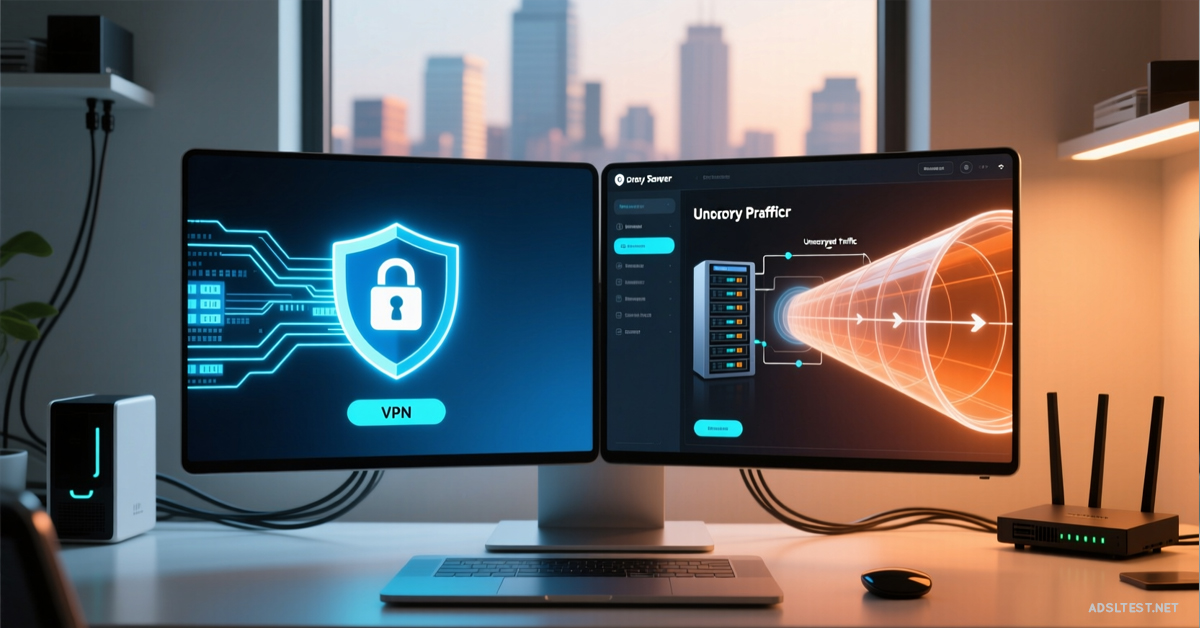
The simplest analogy: A proxy is a detour sign. A VPN is an armored tunnel.
A Proxy Server acts as a middleman. It fetches a website for you and passes it back. It changes your IP address but does not encrypt your data. Your traffic is visible.
A VPN (Virtual Private Network) creates an encrypted tunnel between your device and the VPN server. It changes your IP address and scrambles all your data, hiding it from your ISP, network admin, and anyone else on the path.
Head-to-Head Comparison: When to Use Each
Feature
VPN
Proxy Server
Encryption
✅ Strong, End-to-End
❌ None
Privacy from ISP/Network
✅ Complete
❌ None
Hides IP Address
✅ Yes
✅ Yes
Speed
Slower (due to encryption)
Faster (no encryption overhead)
Best For
Security, privacy, public Wi-Fi, torrenting
Quick geo-unblocking, basic web scraping
Scope
System-wide (protects all app traffic)
App-specific (usually just browser or one app)
Cost
Paid subscription (for reliable service)
Often free (with major privacy risks)
The Proxy: A Tool for Specific, Low-Stakes Tasks
Use a proxy for convenience, not security.
Good Use Cases:
Bypassing a simple geographic block to watch a region-locked YouTube video.
Web scraping or checking localized search results.
Bypassing a basic content filter on a school or work network (where security isn’t the concern).
The Major Risk:Free proxies are dangerous. They can log your traffic (including passwords), inject ads, or even distribute malware. You are handing your unencrypted data to a complete stranger.
The VPN: Your Full-System Privacy Solution
Use a VPN when security and true privacy matter.
Essential Use Cases:
Using public Wi-Fi (encrypts your data from snoopers).
Torrenting/P2P file sharing (hides your activity from your ISP).
Protecting sensitive communications (work, banking, personal messages).
Bypassing censorship in restrictive countries (with obfuscated servers).
The Requirement: You must use a paid, reputable VPN provider with a clear no-logs policy. Free VPNs often have the same risks as free proxies.
The Critical Test: Can Your ISP See What You’re Doing?
This is the clearest way to understand the difference.
With a Proxy: Your ISP CAN SEE that you’re visiting netflix.com, yourbank.com, or a torrent site. They just see the traffic going to the proxy server first.
With a VPN: Your ISP ONLY SEES encrypted gibberish going to your VPN server’s IP address. They have no idea what you’re doing inside that tunnel.
The Simple Decision Flowchart
Ask yourself:
“Do I just need to quickly appear from another country for a single website?” → You can risk a reputable paid proxy (but a VPN is still safer).
“Am I on public Wi-Fi, handling private data, or hiding my activity from my ISP?” → You must use a VPN. A proxy is dangerously inadequate.
The Bottom Line: A proxy changes your digital location. A VPN changes your location and provides a private, secure escort. For any task involving passwords, personal data, or real anonymity, the choice is non-negotiable: use a VPN. A proxy is a clever trick; a VPN is a security strategy.
2026 Global Internet Speed Ranking: Top 10 Countries with the fastest internet speed
Fastest Internet in Europe: 2026 Country Rankings
Cities with the Fastest Internet in the World (2026 Data)
Global Mobile Internet Speed Ranking for 2026 : Top 10 countries