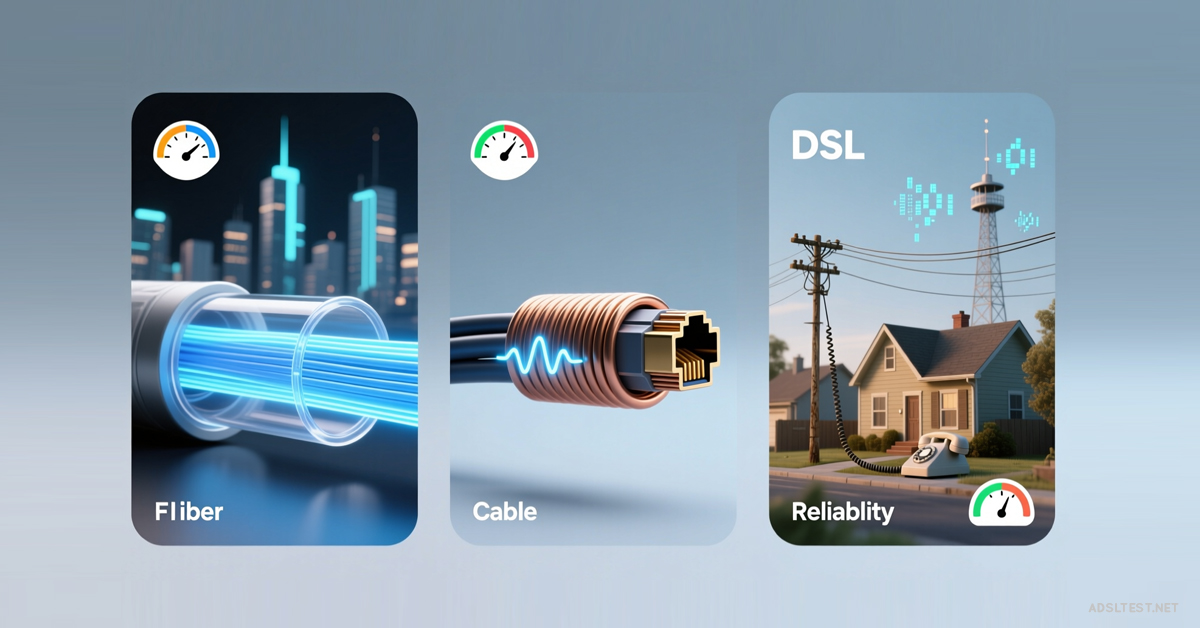
Choosing an internet plan means choosing the wire that comes into your home. Each technology—Fiber, Cable, or DSL—has a different DNA that dictates your speed, reliability, and future. Let’s cut through the marketing to see which wire truly fits your life.
The Core Difference: It’s All About the Pipe
The technology determines your ceiling and consistency.
Cable (Coax):Copper lines (like TV cable). Fast downloads but limited uploads, shared with your neighborhood (congestion).
DSL:Old phone lines. The slowest option, with speed degrading sharply over distance from the provider’s hub.
Head-to-Head Plan Comparison
Feature
Fiber Optic
Cable (Coax)
DSL
Max Download Speed
1 Gbps – 10 Gbps+
100 Mbps – 1.2 Gbps
5 – 100 Mbps
Max Upload Speed
1 Gbps – 10 Gbps+ (Symmetrical)
5 – 50 Mbps (Asymmetrical)
1 – 20 Mbps
Typical Latency (Ping)
5-15 ms (Excellent)
15-40 ms (Good)
30-80 ms (Poor)
Reliability
Highest (Immune to weather/EMI)
High (Can suffer from congestion)
Low (Degrades with distance/weather)
Best For
Future-proofing, heavy uploads, gaming, WFH
Families, streamers, general use
Light users, basic browsing, very budget-limited
The Real-World Cost Analysis
Price tells the true story of value.
Fiber Plans: Often $70-$100/month for 1 GIG symmetrical. Higher entry cost for transformational performance.
Cable Plans: The value middle. $50-$80/month for 300-500 Mbps download (but only 10-20 Mbps upload). Price hikes are common after promo.
DSL Plans: The budget trap. $40-$60/month for often sub-50 Mbps speeds. You pay for “availability” not performance.
The Hidden Cost: With Cable and DSL, you often need to rent their modem ($10-$15/month). With Fiber, the ONT (Optical Network Terminal) is typically included in the fee.
The Deal-Breaker Scenarios
Choose FIBER if: You game competitively, upload large files (video editing, backups), have multiple security cameras, or run a business from home. The symmetrical upload is a non-negotiable.
Choose CABLE if: You are a streaming-heavy household but don’t do major uploads. It’s the workhorse for most suburban families if the local node isn’t oversold.
Choose DSL if: It is your only wired option other than satellite, and your usage is strictly email, browsing, and maybe one SD video stream. It’s a last resort.
The Congestion Test: The Cable Killer
Cable’s fatal flaw is neighborhood peak hour slowdown. To check if your area is affected:
Run a speed test at 2 PM on a weekday.
Run the same test at 8 PM on a weeknight.
If your speed drops by 50% or more at 8 PM, your cable node is congested. Only Fiber or 5G Home Internet can fix this.
Final Verdict: This isn’t just a speed choice—it’s a lifestyle infrastructure choice. Fiber is the dedicated highway. Cable is the shared bus lane that gets jammed at rush hour. DSL is the country road that gets muddy in the rain.
If Fiber is available at your address, the comparison ends. It is the only technology built for the next decade of internet use. If not, Cable is your capable backup, and DSL is the sign that you should seriously consider 5G Fixed Wireless or Starlink as a modern alternative.
2026 Global Internet Speed Ranking: Top 10 Countries with the fastest internet speed
Fastest Internet in Europe: 2026 Country Rankings
Cities with the Fastest Internet in the World (2026 Data)
Global Mobile Internet Speed Ranking for 2026 : Top 10 countries